

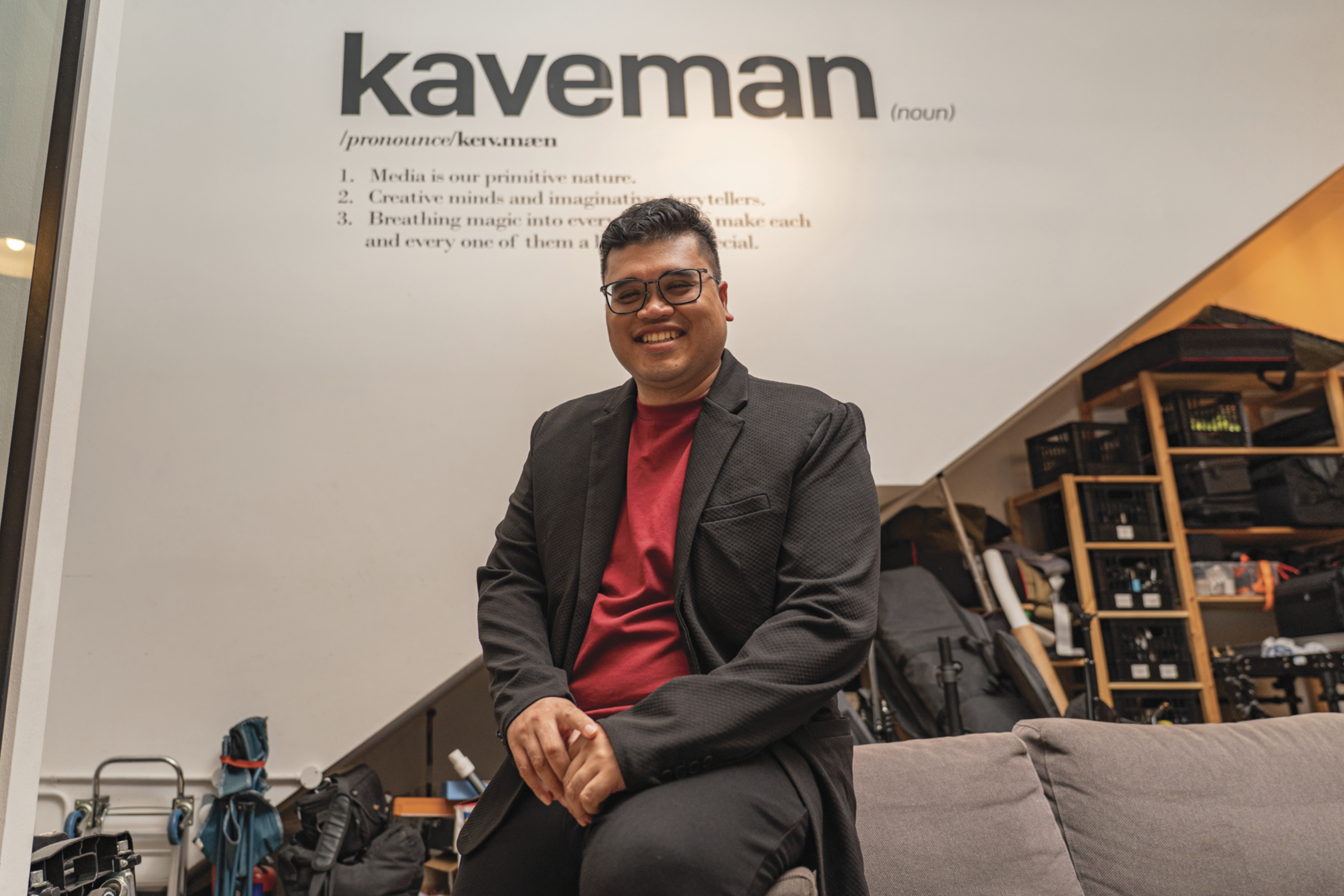
The meeting was not going well. Across the table sat a client who was deeply troubled by the video production process, and the tension in the room was palpable. Then the director beside him leaned over and said, in Mandarin, “Don’t worry, you’re working with Kaveman. You’re in safe hands.”
Khairul Anuar, known as Khy to everyone who knows him, does not speak Mandarin. Yet he has thought about that sentence ever since. A stranger had used his company’s name as a way of saying that the worrying could stop.
That is the business Khy has spent nearly two decades building. Ask him what Kaveman Productions sells, and he will let you answer first. Video, you might say, or content. “You’re right,” he will reply. “And you’re wrong. I sell assurance. I help my clients sleep at night. Or get promoted.”
An Upbringing of Duty
Khy grew up in an ordinary Singapore household where work meant duty. There were no business owners in the family and no startup communities of the kind young founders take for granted today. Like most of his peers, he pictured himself in a suit, working in town.
If anything, his family leaned the other way. Relatives had seen too many ventures fail, and business was close to taboo. When his family discovered he had started a business while still in school, they offered to pay him a salary to stop and focus on his studies.
Khy still cannot fully explain why he declined. “I only knew, somehow, that this was a calling.” Instead of arguing, he opened his files and showed them the jobs, the numbers, and the plans. They gave him their blessing, and their questions kept his accounts honest and his promises realistic. “I am grateful for their care, and for the pressure to show results. It made the business real from day one.”
That first venture, started while he studied Biomedical Informatics and Engineering at Temasek Polytechnic, failed. The failure rewired his thinking. Business stopped being a subject others studied and became something he would learn by doing, and by making mistakes.
The Leap, Such As It Was
There was no cinematic moment when Kaveman began, and Khy is honest about that. After National Service, he saw a chance to use media as a stepping stone and, with that early venture behind him, decided he could help make it work. Nearly two decades later, he likes to say he is still on that stepping stone.
“What I remember is not bravery but a kind of shrug,” he says. “I did not know enough to be properly afraid. If I had known how hard it would be, I might have thought twice.”
The name came from an early plan to run training, and from the irony of a caveman giving lessons, something primitive yet knowledgeable. The authorities required a physical school building before anyone could use the word “Academy”, so the company became simply Kaveman.
The leap had no safety net. Equipment was rented first and bought only when funds allowed, a discipline that stuck. Today, almost all of Kaveman’s on-location equipment is owned outright. The real fears came later, when other people’s livelihoods became tied to the business. His first hire quit a job to join him before Khy was ready to hire. “It taught me permanently that when you employ someone, you take on financial responsibility for their household.”
The Reframing That Changed Everything
Over the years, clients began asking in difficult moments, “Can you do that Kaveman magic?” Khy is quick to demystify it. “The magic clients describe is, in truth, a stack of unglamorous habits repeated for nearly two decades.” Nearly all of Kaveman’s business still comes from returning clients and referrals, and the company has grown without spending a dollar on advertising.
The defining shift in its history was a sentence rather than a contract. Khy stopped describing what Kaveman does and started describing what it does for the client. “The moment I stopped describing what we do and started describing what it does for the client,” he says, “everything downstream changed.” Video became the vehicle, and assurance became the promise: deliver on the deadline, communicate before being chased, and own the problem on the ground.
Tested, Repeatedly
Khy is candid that longevity does not get easier. “It gets different. You know what to do, but you face newer, bigger challenges.”
When the COVID-19 lockdown halted production across the industry, Kaveman decided within days to pivot entirely to digital production, from remote direction to live-streamed events. Qualifying as an essential service, it spent the lockdown producing content that kept communities informed and connected.
The closest Khy came to losing the company was in 2024, when the business took a six-figure loss in the first half of the year. “I went to work every day. I put in the same effort as always. And the effort simply did not convert into earnings. That is the most painful part of an entrepreneur’s reality.” Through it all, nobody on the team felt the gap. What carried him through was rigour on cash, honesty about what was working, and his faith, which reminds him that effort is his responsibility while outcomes were never his to command.
Every Wave, Early
Khy has lived through streaming, the pandemic pivot, and now artificial intelligence. Each wave was announced as the death of the industry, and each turned out to be a repricing instead. “The industry that reinvented itself every ten years now does so every two or three. Adaptability is no longer an advantage. It is the entry fee.”
Kaveman has consistently moved early. It ran its own server and network infrastructure before that was common for a firm its size and experimented with live streaming before it went mainstream. Today, its workflows are AI-assisted from ideation through scripting, transcription, and editing support. The company also built its own internal project management system and an AI interviewer platform for hiring.
Yet Khy insists that tools alone are not enough. When Kaveman’s team, backed by nearly two decades of craft, went up against computer science graduates producing AI-generated content, Kaveman outperformed them significantly. “You need the experience to know what good looks like,” he says. “Nobody asks which violin made the music beautiful. They ask who was playing it.”
Building People, Quietly
Spend time inside Kaveman, and its real product starts to look like people. Producers who once doubted they could lead a shoot now run projects end to end and mentor others. Every quarter, Khy holds one-on-one “kopitalks” with each team member, development conversations over a figurative kopi, and some of the company’s most important decisions have come out of them.
The culture runs on trust more than rules. Khy tells every new hire that working fast will earn trust and rest, never a heavier load. A mentee once messaged him, unprompted, describing what he does as “building people from the shadows.” That message, Khy says, meant more to him than any award.
Beyond the company, Khy believes skills and confidence travel further than charity. Kaveman gives students real-world production experience through work with a local polytechnic and university mentorship programmes, and it once ran a complimentary masterclass on podcasting and AI tools for youth leaders. In 2026, Khy represented Singapore at the Youth Development Forum in Berlin and spoke to diploma students in Vietnam about turning ideas into products.
Rooted in Singapore
“Singapore is where my entire story makes sense,” Khy says. “This is a country that turned reliability into a national brand, and in many ways, my company is a small echo of that.” Kaveman’s work centres on trust-heavy institutions, and much of it involves heritage and community content that holds different communities’ stories with equal care. When a project runs into trouble, a modern gotong royong takes over, and titles dissolve.
Asked once for the most spectacular moment of his journey, he said there was none. “I have simply been around, consistently, for a long time.”
The Legacy of the Kaveman
Khy is now grooming Kaveman’s next generation of leaders, because “a business that depends entirely on its founder is fragile.” His advice to aspiring entrepreneurs is to take the first small step and accept that fear and uncertainty are normal. He is also honest that entrepreneurship is not for everyone. He recalls a Chinese idiom about a man who filled his home with dragon carvings, then ran when a real dragon appeared at his window. “Ask yourself honestly: do you love the dragon, the work, the weight, the unglamorous days, or only the idea of being seen with it?”
The legacy he hopes to leave is simple: that the people he built go on to build others. “Building people is the point of it. If the kaveman is remembered for the people he taught to make fire, that is enough.”
Website: https://www.kaveman.sg/






Follow us for more tips & insights
Join our email list for exclusive updates