

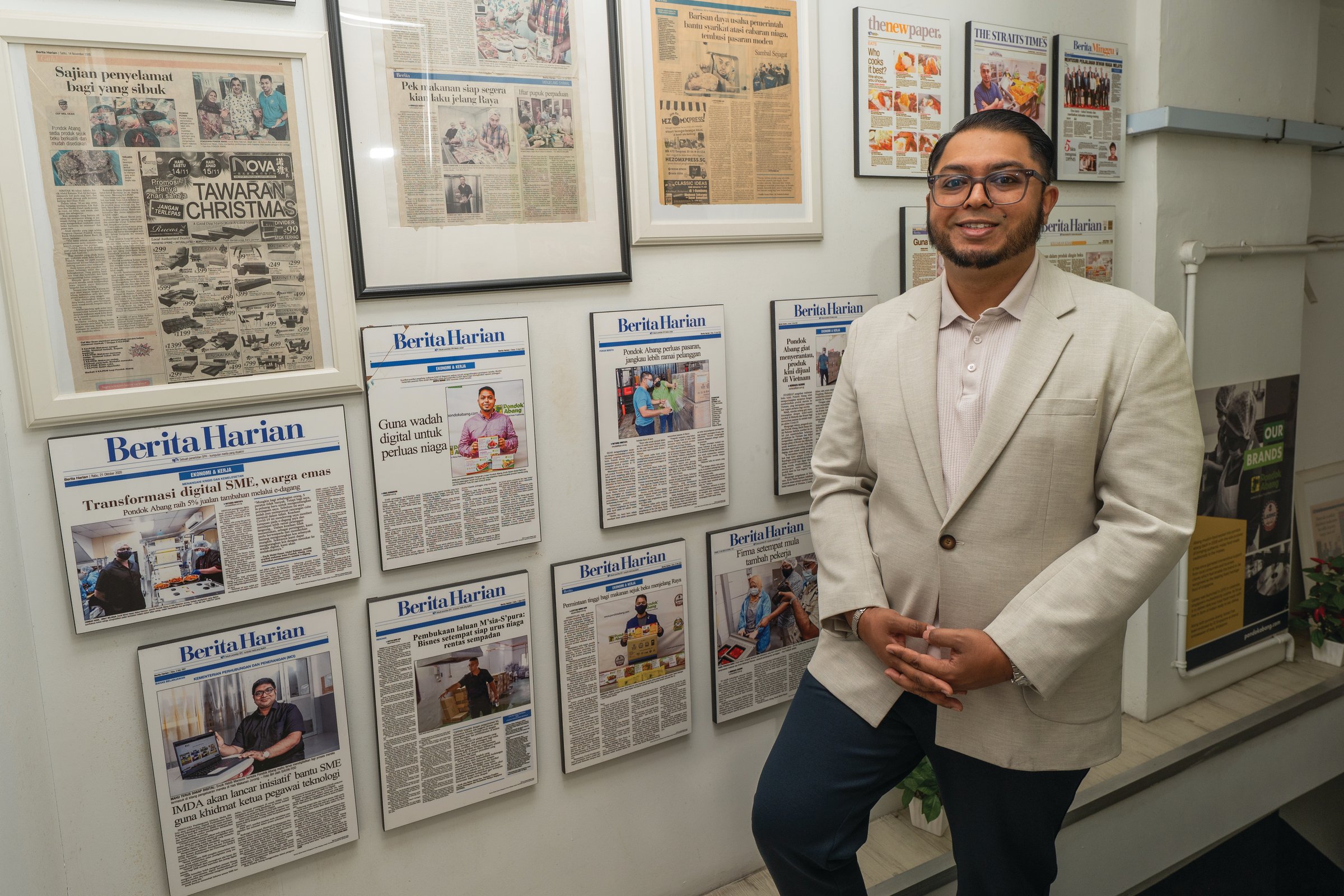
Ask Hasan Abdul Rahman about the legacy he hopes to leave, and he does not talk about building a successful company. He would rather be remembered as someone who “inherited something from the generation before him, made it stronger, and then created opportunities for the generation after him.”
Hasan is open about the fact that Pondok Abang’s growth under his leadership rests on foundations his father, Abdul Rahman bin Yad Ali, laid decades earlier. In the late 1970s, his father drove a refuse truck in the mornings. In the afternoons, he carried around 50 kilos of Indian curry puffs on his motorcycle to sell outside factories in Tuas during the workers’ tea breaks.
In the 1980s, he opened a food stall in Jurong West selling halal Chinese rojak, which was hard to find at the time and earned him the nickname “Abang Rojak”. A move to Clementi in the 1990s followed, and in 2007, a new outlet in Changi Village was named Pondok Abang to reflect the area’s village feel. Soon after, every shop took on the Pondok Abang name. Throughout the journey, Hasan’s mother, Kalsom Bee Binte Shaikh Daud, was the backbone of the business, cooking dishes for sale and later helping to manage the Clementi outlet while raising the family.
Watching his parents taught Hasan that running a business carries responsibilities far beyond money, to family, employees, customers, suppliers, and the wider community. When people ask when he started helping out, he jokes that it was “since I was in my mother’s stomach”. Even while pregnant with him, his mother was packing Air Kathira, a cooling drink popular during Ramadan, for the business.
An Accidental Entrepreneur
Despite his deep respect for his parents, Hasan never planned to take over Pondok Abang. He began helping at the shop at the age of seven and disliked the early mornings and long, gruelling hours. Only as he matured did he understand why his parents worked so hard.
The turning point came after National Service. Hasan wanted to return to school, and his parents agreed to support him on one condition: he would help out at the shop. He began working in the business in a more professional capacity in 2011 and officially took it over in 2016.
By then, Pondok Abang had grown well beyond his father’s original stall and included a butchery section. Hasan suddenly felt the full weight of his parents’ legacy and of every livelihood that depended on the business. With his parents approaching 60, he resolved to grow Pondok Abang to the point where they could retire.
Preserving a Legacy by Transforming It
“There is a major difference between observing a family business and suddenly becoming responsible for its future,” Hasan says. He examined every aspect of the business, from operations to finances, and asked whether it could survive another generation in its existing form.
His conclusion was clear. “Sometimes preserving a legacy requires transforming it.” Hasan set out to keep the food, values, and identity his parents had built while helping the business evolve for modern markets. Today, Pondok Abang has evolved into Singapore’s Muslim-owned full-chain halal food manufacturer, with capabilities spanning food manufacturing, food safety systems, supermarket distribution, OEM and private-label production, food service supply and regional distribution.
The transformation did not happen overnight. Cash flow and capital were the biggest early hurdles, and Hasan had to reinvest carefully and grow step by step. “What I inherited was not abundant capital, but something far more valuable, the foundation my parents had spent decades building,” he says.
The market was also sceptical. Hasan vividly remembers suggesting to a stall makcik that she could stop spending an hour and a half boiling beef lungs and buy Pondok Abang’s pre-boiled, pre-cut product instead. She scolded him, indignant at the idea of selling someone else’s food.
Hasan also knew he lacked the know-how to run a growing business. For two years, many of the changes he tried did not work as he had hoped. Undeterred, he sought out a mentor, who over a year and a half helped him see that a business needs a clear vision, mission, and core values.
A Series of Breakthroughs
From there, the breakthroughs followed. Entering major supermarkets widened Pondok Abang’s reach, while building manufacturing capability changed the kind of company it could become. OEM capabilities opened another dimension for the business, and recognised food safety standards moved it towards becoming a serious manufacturing organisation. Most recently, Pondok Abang brought its products into Malaysia.
In 2026, Prime Minister Lawrence Wong highlighted Pondok Abang’s journey at the National Day Rally, from its humble beginnings to manufacturing and regional expansion. Hasan’s father was at the rally beside him, and the moment was especially poignant for the family. The year also marked 20 years since Pondok Abang’s incorporation and 10 years under Hasan’s stewardship, alongside the Spirit of Enterprise Award.
Giving Back to the Community
As Pondok Abang grows, Hasan is increasingly mindful of its environmental impact. The company repurposes meat trimmings from processing into products such as meatballs so that nothing is wasted. Hasan hopes to acquire specialised equipment to clean used cooking oil for reuse, and Pondok Abang was among the first to review electric refrigerated trucks in Singapore. Current models do not yet meet its capacity needs, but he is keeping a close watch.
Giving back sits at the core of the company. During Hari Raya Haji, Pondok Abang fulfils Qurban on behalf of customers for communities in Yemen, India, and Indonesia. For Singapore, it fulfils the Qurban in Australia and flies the meat back for distribution to local beneficiaries through the People’s Association and mosques in Yishun and Jurong. Through its Sinar Harapan Project, it offers heavily discounted prices to Muslim organisations so they can distribute food to thousands of households during Ramadan and Hari Raya.
That philosophy extends beyond Pondok Abang. Hasan also serves on boards and leadership platforms including SMCCI, raiSE and the mosque sector, contributing to entrepreneurship, social enterprise, governance and the wider community. “As our capacity to do more increases, so should our responsibility to contribute and create benefits for others,” Hasan says. He also sees Pondok Abang as part of Singapore’s food security effort, engaging regularly with the Singapore Food Agency and sourcing quality meat and poultry from overseas.
Growing People Alongside the Business
When hiring, Hasan prioritises a willingness to learn, because new technology can mean relearning processes from scratch. Once staff join, he sends them for courses in hygiene, workplace safety, and even languages, and he sees the results in sharper practices and more proactive mindsets. He even treats government and agency audits as training opportunities.
His staff return that faith. Hasan recalls a manager whose passport issue meant he could not ride his motorcycle across the border. Rather than stay in Malaysia, the manager crossed the checkpoint on foot and remained in Singapore for 30 days until it was resolved, leaving his wife and daughter behind for a month. For Hasan, it showed extraordinary loyalty and commitment.
That commitment reflects the values Hasan instils in Pondok Abang. Intention means approaching responsibilities with purpose. Knowledge means continually learning and building the capabilities to fulfil them. Benefit means ensuring the work creates value for colleagues, customers, families, and the wider community.
Still Standing, Still Building
Within the next ten years, Hasan hopes Pondok Abang will become a recognised Singapore halal food brand with a strong regional and, eventually, international presence. For now, he is strengthening its presence in Singapore while gradually expanding manufacturing and distribution into Malaysia. The company is shifting its focus from individual food shops to clients with multiple outlets, and pursuing more retail placements to grow brand awareness. In the long term, Hasan’s goal is a company capable of surviving generations.
A Steward for the Next Generation
To Hasan, the spirit of enterprise means adapting to cycles of disruption that now arrive closer together than ever. His advice to young entrepreneurs is to reflect deeply on why they want to start a business, because passion alone is not enough without a solid plan and a genuine gap in the market. He encourages them “to start small to minimise risks until you stabilise, and then slowly transition”, to find a coach or mentor, and to build a network. “Business is ultimately about who you know, and I would not be where I am today without those face-to-face networking sessions.”
Hasan sees himself as a steward of this phase of Pondok Abang. When the next generation takes over, he hopes they will inherit more than a company. He hopes they will inherit its values and heritage, along with the responsibility to make it even stronger for those who follow.
Website: https://pondokabang.com/



Follow us for more tips & insights
Join our email list for exclusive updates