

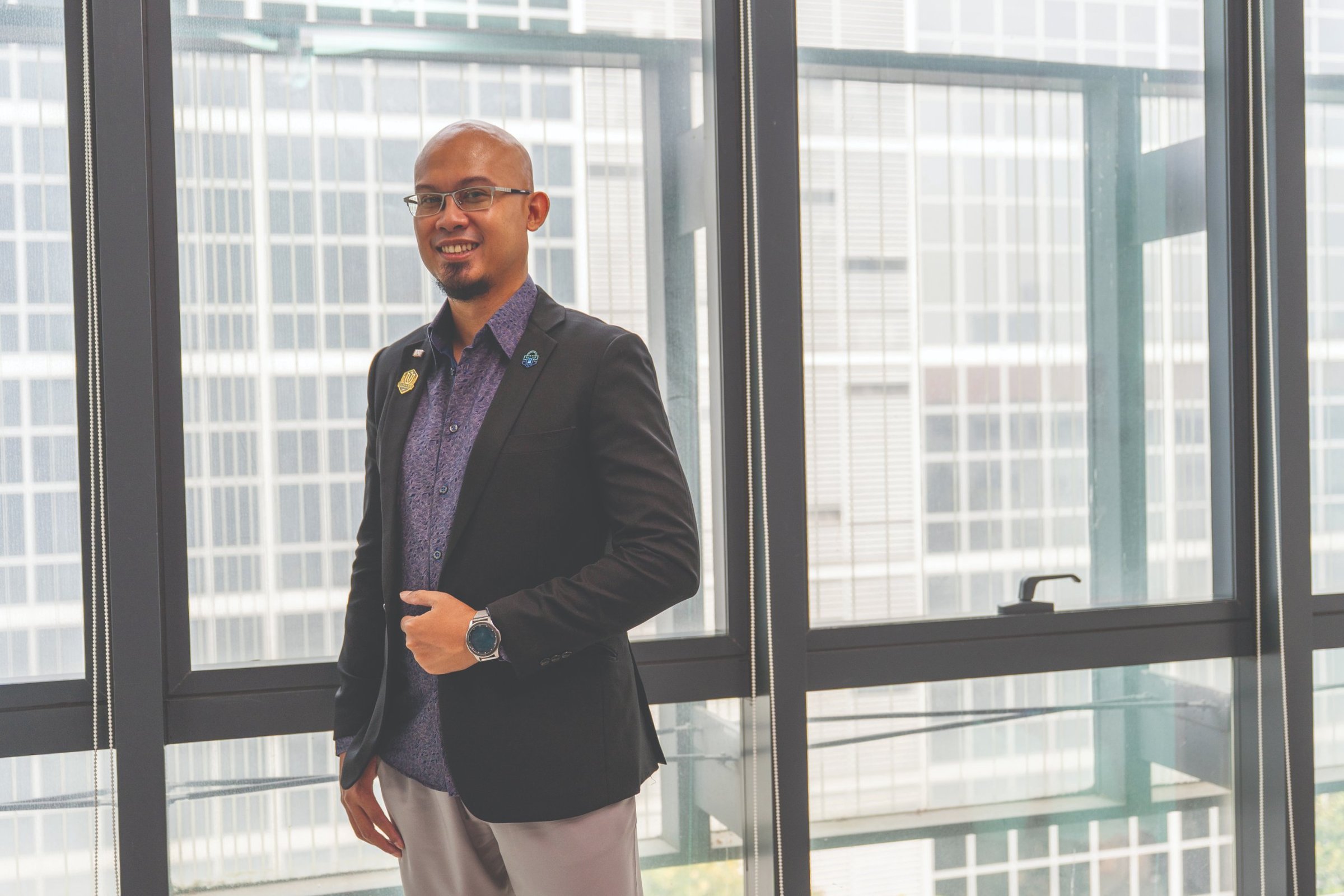
The man at the whiteboard is asking three questions, and none of them are about technology. “Where are you now? Where do you want to go? What is standing in the way?” The room is full of experienced professionals mapping out how their company really works. Nobody has mentioned artificial intelligence yet, and Muhammad Termidzi Azmi, known to everyone as Midzi, is in no hurry to be the first.
That restraint is his method. AgentSAMUR.AI helps Singapore’s small and medium enterprises put AI to work, and the firm runs on the same systems it builds for clients. The method itself came from an unusual place, and it took the end of one career and a long road back for Midzi to find it.
Learning How People Change
Midzi grew up in a family that treated learning as a lifelong responsibility. His late father, Haji Azmi, was a technician who attended night classes in his forties simply because he enjoyed them. His mother, Madam Noraini Mohamad Jaffar, served in the civil service for close to forty years and taught him to keep looking for another door when the first one closed.
In 2009, he joined the Singapore Prison Service and served nearly fifteen years, close to eight of them in the elite Singapore Prisons Emergency Action Response Force. As he began talking with the men in his care, he came to an uncomfortable realisation. “We often talk about silver spoons and golden spoons, but we fail to realise that some people are born with no spoon at all.”
He decided he wanted to be part of their change, rather than their containment alone. While serving full time and raising a family, he completed a psychology degree, and in 2017 he became a prison counsellor, preparing men for life after release. Counselling taught him a lesson he still relies on: people rarely change because someone tells them to. They change when they understand change is possible and trust the person guiding them.
One idea stayed with him so firmly that he named it the garden philosophy. When life feels overrun, do not pull the weeds one by one. Plant trees instead, and let something better compete for the same soil. He had no idea he would one day need that advice himself.
Beginning Again
Technology was already part of how Midzi solved problems. As a counsellor, he helped develop a case allocation system that saved roughly sixty man-hours a month. In 2021, still in uniform, he completed a six-month software engineering bootcamp, learning to code around his shifts.
That same year, Midzi survived being shot in the head by a less-lethal round. The physical pain and mental scars that followed led to his retirement from the service on medical grounds in December 2023. The injury took more than his health. It took the identity he had worn for nearly fifteen years.
Funded by his family’s savings, Midzi retrained in cybersecurity. In 2025, he joined the inaugural AMPxSANS cohort, earning three GIAC certifications within four months and delivering the cohort’s valedictory address. Yet the certificates did not open the doors he had hoped. For roughly twenty months, he lived on savings and sent out more than two hundred applications.
The offers that did come forced hard choices. He turned down a well-paying role because the company’s core business conflicted with his values, and he gave up a coveted place whose multi-year bond would have claimed the years he wanted to bet on himself. Both decisions came from the Arabic idea of amanah, the responsibility created when someone places their trust in you. “Money that costs you your amanah is expensive money,” he says.
After nearly fifteen years in one organisation, networking was unfamiliar, so he sought it out through hackathons, community programmes, and industry events. In his first year outside the service, he met more than two hundred business owners and leaders. The rejections began to look different. “The market was not saying I was worthless. It was saying I was invisible.” Once he stopped waiting to be chosen, the invitations came. “I stopped asking for a seat at someone’s table. I built my own table.”
The Workaround That Became the Business
The table began as a different idea: a platform connecting Muslim consumers in Singapore with Muslim service providers. With no engineering team or staff, Midzi built a team of AI agents from scratch, with a main AI taking his instructions, manager agents coordinating different areas of work, and specialist agents handling narrower tasks.
What began as a way for one founder to work with the efficiency of a team soon became more interesting than the platform itself. Other small companies faced the same constraint. They needed more capability without adding headcount, along with someone who could connect the tools to the way their work actually ran. What Midzi had built to survive as a one-man company was the very thing he could offer.
In December 2024, during a hackathon organised by Div0, Singapore’s cybersecurity community, he incorporated his company on his laptop. Barakah Bridge Pte Ltd began trading as AgentSAMUR.AI, pairing AI agents with the discipline of the samurai. Midzi is clear, though, that while intelligence can come from a machine, a human still decides which problems deserve solving and bears responsibility for the result.
He later built SAHABI, an operating system that holds the company’s information in one place and surfaces the next thing that matters rather than a wall of tasks. The company has stayed deliberately lean, with Midzi personally handling the diagnosis, training, and client relationships. His first paid work came during Ramadan in 2025, when he ran a community workshop on AI despite never having run a workshop before. Small as that first income was, his wife Nurfarhana treated it as a new beginning to be grateful for.
Trust Before Technology
The method proved itself at Emaan Inspection Pte Ltd, which ran job assignments through messages, spreadsheets, and knowledge passed between staff. The pilot cut assignment turnaround from as much as a full day to between five and ten minutes. Eighteen staff from non-technical roles then went on to build a working Telegram AI agent by themselves.
In Midzi’s experience, the obstacle is rarely the software. It is the staff member quietly worried about being replaced. That is why he never opens a conversation by asking which AI product a client wants. He maps the workflow with the team rather than for them, so the people who know the job best can decide where a machine could help. The repetitive work is handed over, the judgement stays with people, and buy-in is earned. “My counselling background is why the adoption actually sticks,” he says.
Teaching People to Direct the System
Much of Midzi’s work happens in classrooms. He has run sessions for parents, youths, seniors, business owners, and mid-career workers, including mosque workshops where residents typed their first prompts in English and Malay. “The scarce skill is no longer doing the task. It’s directing the system that does it. And directing is learnable.”
He encourages people to treat AI as a thinking partner, a mirror rather than an oracle, and he insists that non-technical learners can embrace it too. Having started over as an adult himself, his message is simple. “You’re allowed to be a beginner.”
That conviction reaches beyond technology. Midzi founded a fathers’ community at his daughters’ school and contributes to food distribution drives and free workshops while still building his company. “You do not wait until you are successful to help others. You give while you are still climbing.”
Building Your Own Table
To Midzi, the spirit of enterprise means building a meaningful path when the existing one closes, and being accountable for what you build on it. Rather than erase his former career, he learned, built, met people, and created a place where his experience could be useful, without ever taking on work he could not honour.
He now hopes to grow AgentSAMUR.AI into a regional reference for responsible AI adoption, build an academy for non-technical workers and small business owners, and develop SAHABI to help other founders. He credits God first, along with his mother’s prayers, his wife’s unwavering belief in him, and his two daughters, who gave purpose to every difficult step.
Looking back, he no longer sees counselling and AI adoption as separate careers. “In counselling, my job was selling hope. I thought I left the business of selling hope when I hung up my uniform. Turns out I hadn’t. I had only changed tools.”
Website: https://agentsamur.ai/





Follow us for more tips & insights
Join our email list for exclusive updates