

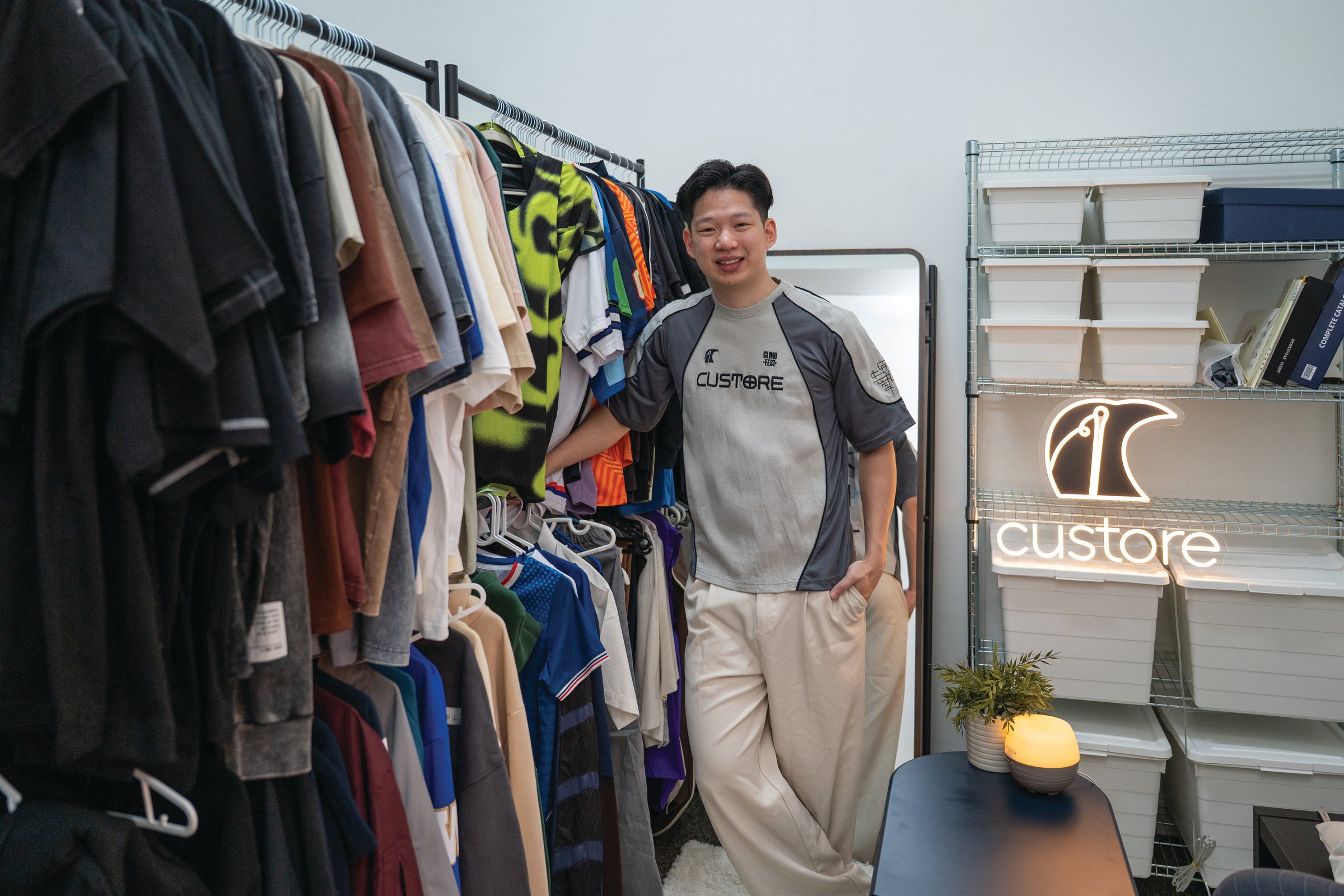
During his years at Singapore Polytechnic, Zachary Chua kept returning to one question: Why is there no one who can properly handle this for us? It came to him every time he rushed to sew costumes for his upcoming dance performances. He stitched during training breaks and even on the MRT ride home. None of his teammates were trained to sew, so the results were only ever passable.
The question resurfaced a few years later when Zachary went searching for someone to produce distinctive custom merchandise. He scouted seamstresses and suppliers across Singapore, yet only one company could deliver what he needed, and its prices were steep. The search confirmed something he had long suspected. The gap he had felt as a dancer stretched across fashion and apparel as a whole.
An Early Spark in the Classroom
Zachary’s flair for entrepreneurship showed early. His highest polytechnic scores came from his entrepreneurship modules, the first of which was taught by a former startup founder who threw his students into the deep end. The class sent them off campus to interview real customers and ended with a pitch to actual investors.
What Zachary enjoyed most was the creative process of identifying a problem and imagining ways to solve it. He traces that creativity to his faith. Having grown up in church, he learnt to trust that his life was in God’s hands, and that trust gave him the confidence to try new things, from dance to business.
The idea for Custore first took shape in his second year of polytechnic. His lecturer praised the proposal but felt that his team was not the right group to build it. The comment stayed with Zachary. “It made me see Custore as more than a classroom project,” he says. The idea sat on the back burner for a few years, though he held on to the belief that God would guide him in the right direction.
His vision was to make custom goods accessible to anyone with an idea, rather than only to large brands with big budgets. Custore would also give artisans and niche creatives the space to shine and a way to connect with validated buyers.
Working Like a Consultancy
Zachary set out to make Custore work more like a consultancy than a factory. As a managed custom apparel partner, Custore first seeks to understand each customer’s objective and turns it into a workable brief. The team then explains budget and production trade-offs before guiding the product through design and sampling into production.
One early order showed him why that guidance was needed. A church camp client ordered several hundred shirts and supplied its own size chart. Custore’s supplier spotted that something looked wrong, and Zachary checked with the client, who chose to proceed as specified. The shirts came out like dresses, yet they matched the chart exactly. The episode strengthened his resolve to be a reliable partner who looks out for customers at every step.
The learning curve was steep. Zachary had to understand fabrics and garment finishings, along with which manufacturers could make what, and in what quantities. Sourcing took him overseas, and working across borders meant adapting to different processes and business ecosystems. To correct the assumptions he had made, he flew to Jakarta and other parts of Indonesia to see how manufacturers actually operated.
Through these trials, his Christian faith kept him grounded. He believed that even failure would equip him for the next chapter of his life. The doubts never fully disappeared, but his faith kept him moving.
Changing Direction
With a firmer grasp of production, Custore faced a new challenge. The company had first focused on onboarding manufacturers, then shifted to a customer-facing service model to generate revenue and gain deeper customer insight. Team members who had handled onboarding suddenly found themselves running sales and project fulfilment.
Client expectations varied widely. Some customers knew exactly what they wanted, while others arrived with only an inkling and needed guidance through the entire process. Standardising operations without compromising on quality took many rounds of iteration. In the early years, Zachary also funded Custore with his own earnings, reinvesting what he could while keeping its standards intact.
Dressing the Dance Community
That dedication to quality paid off when dancers and competition teams came calling. Zachary understood how intricate dance outfits could be, and Custore created unique competition costumes for them. Audiences and rival teams soon began asking who had made the outfits.
The praise took Zachary back to the days when he stole pockets of time to sew his own costumes. He felt deep satisfaction knowing that other dancers could now wear well-made costumes without sacrificing so much time and energy.
Setbacks still came. A large prospective client once decided not to proceed with a major order, and Zachary felt discouraged by their lack of trust. Instead of asking the client to reconsider, he produced a sample to show the quality Custore could deliver. The client was impressed and chose to go ahead. The experience taught him that showing his work closed deals far more effectively than asking for faith that had yet to be earned.
Zachary also rebuilt Custore’s landing page and created event management tools with the help of AI, which took on operational tasks that would otherwise have consumed far more time. “Whoever moves fastest and most intentionally with these tools will have a real advantage,” he says. “At Custore, we are actively working to be that team in our space.”
Courage to Begin
To Zachary, the spirit of enterprise is “the drive to build, to create, and to take risks on ideas you believe in, even when there is no guarantee of success.” He knows that starting a business is genuinely difficult and calls for a particular mindset to step into uncertainty.
His advice to young people begins with AI, which he describes as “arguably the most powerful lever available to young entrepreneurs today.” He also urges them not to wait until they feel ready. “The tendency to overprepare before taking action can lead to indefinite delay. The key is to get comfortable with uncertainty.” Finally, he encourages them to pursue a problem that genuinely moves them rather than profit alone, because passion is what carries a founder through the difficult moments.
Looking to the Future
As Custore grows, Zachary hopes people will remember how it began, with a young dancer frantically sewing costumes and wondering why no one could do it for him.
“I hope people can look at that journey and think, ‘If he could build something meaningful, I can too,'” he says. “The example I want to leave is not perfection, but the courage to begin, keep learning and continue despite self-doubt.”
Above all, he wants his legacy to point towards Jesus Christ. “If my life and Custore amount to something meaningful, all the glory goes to Jesus.”
Website: https://www.custore.co/





Follow us for more tips & insights
Join our email list for exclusive updates